

Why Employee Wellbeing Should Start with Data Visibility, Not Perks



Amazon, JPMorgan, the US Government and many major employers are demanding five days in the office and they’re doing it loudly. But the data tells a more nuanced story, here’s what HR & Payroll leaders need to think about right now…
In the space of six months, return-to-office went from a slow corporate drumbeat to a full-blown mandate. The question for HR professionals isn’t whether this is happening, it clearly is, the question is whether it’s the right move and how to manage the fallout either way.
For much of 2023 & 2024, hybrid working settled into an uneasy equilibrium. Employees had negotiated their two-or-three-day arrangements, managers had quietly accepted them and the battle lines held. Then, starting in late 2024 and accelerating through the first quarter of 2025, something shifted. A wave of high-profile return-to-office mandates broke across the corporate world and this time, they were non-negotiable.
The announcements came quickly and from the very top. This wasn’t mid-level policy tweaking, these were public, CEO-level declarations, often accompanied with a clear message: full-time, no exceptions.
Goldman Sachs, it should be noted, never left. It’s five-day policy has been in place since 2023. For the banks, the return to full-time office work is now an expectation, not a debate.
What’s striking isn’t just the policies themselves – it’s the tone behind them. When JPMorgan’s CEO, Jamie Dimon defended the decision in February 2025, he didn’t mince his words. The message from boardrooms has been consistent: remote work was a temporary response to an emergency and that emergency is now over.
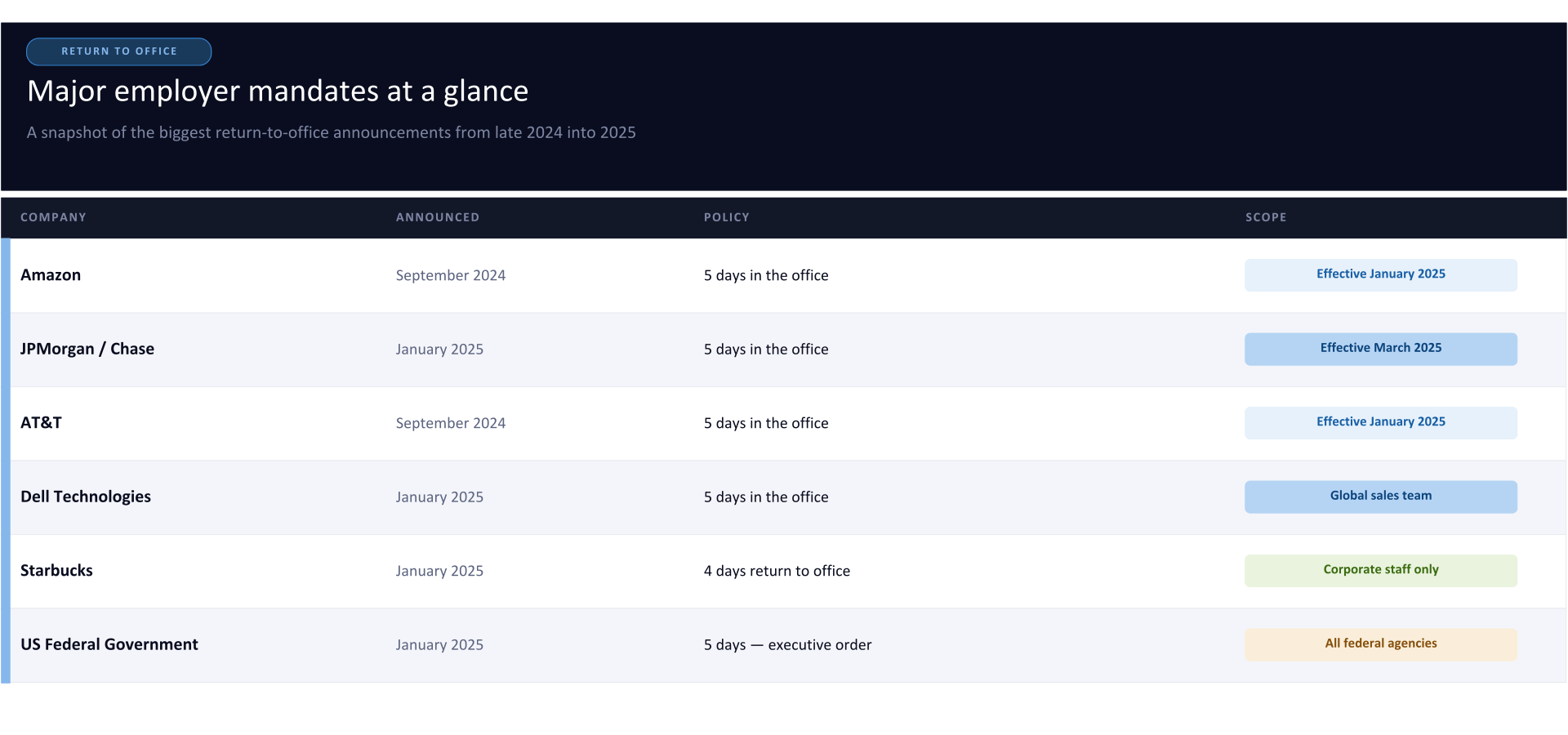
Before HR and people leaders simply follow the herd, it’s worth interrogating the evidence… because the data on remote and hybrid work doesn’t support a blanket rejection of flexibility.
The companies mandating full-time returns are making a bet. The bet is that culture, collaboration and control outweigh the talent attrition risk. The data suggests that bet may not pay off the way they expect.
~HBHR Editorial Analysis, 2025 (find at the bottom of the page)
33%
Of companies are now fully in-person (Flex index, Q1 2026)
35%
Are operating structured hybrid arrangements
33%
Of companies have a fall in quit rates under hybrid working (Stanford/Nature, 2024)
47%
Of high-performers cite flexibility as a top reason to stay (Gartner, 2024)
For HR & Payroll professionals, the return-to-office wave isn’t just a policy debate to observe from a distance. It creates very real operational, compliance and strategic challenges and the organisations that navigate it well will be the ones that thought it through carefully before committing.
Return-to-office policies are not just a people management issue – they carry direct implications for payroll, contracts and compliance. HR & Payroll teams need to think through several interconnected issues before any mandate is communicated.
Payroll & HR compliance checklist, for return to office;
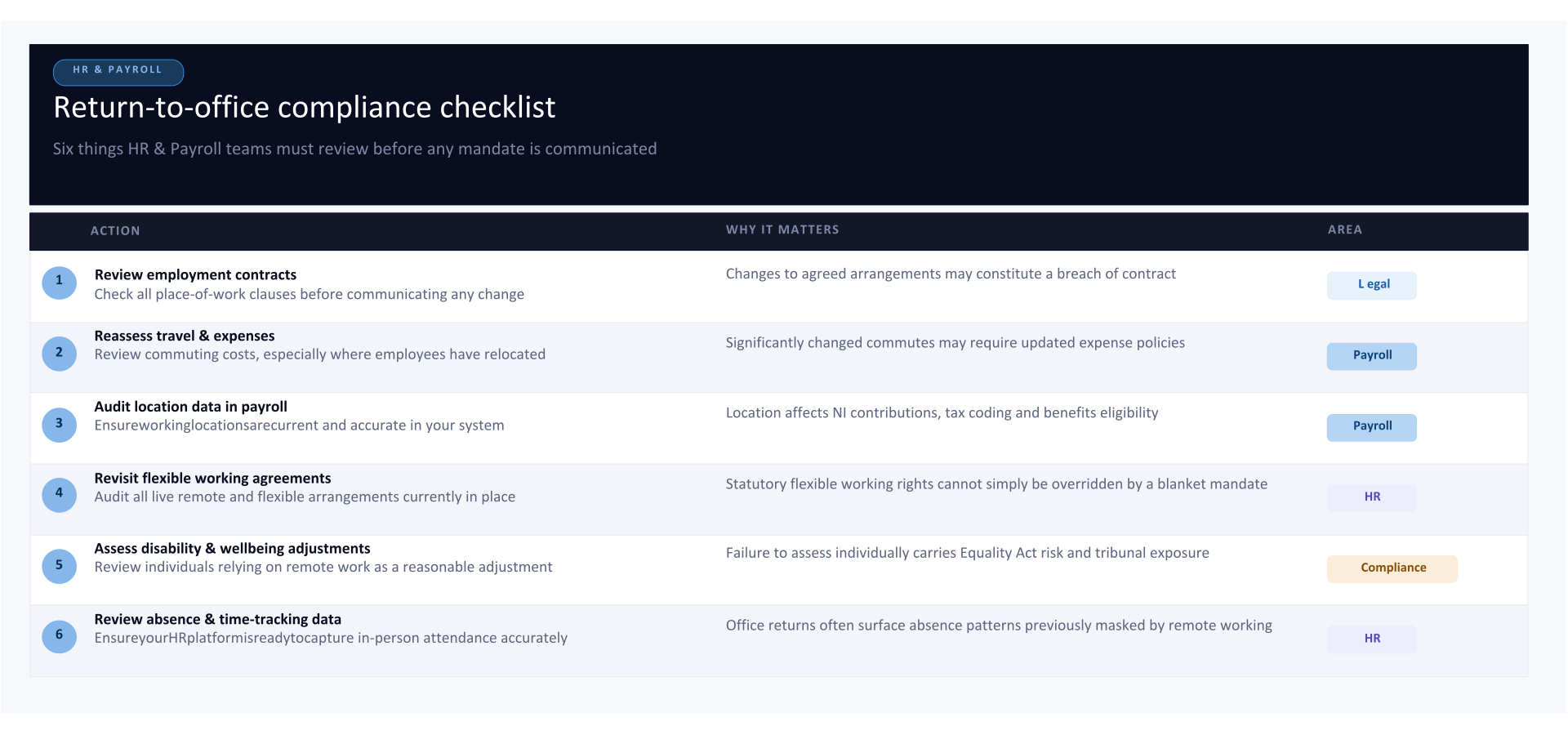
The companies likely to come out of this moment strongest are not necessarily those who went back to the office, or those who stayed flexible. They are the organisations that made a deliberate, evidence-based decision, communicated it well and built the operational infrastructure to support it.
Before committing to any policy change– HR leaders should run a data audit across three areas: voluntary attrition risk (who is most likely to leave and why), contractual exposure (what existing agreements are in place and what’s at risk), and productivity baseline (what do your own engagement and performance metrics actually show?).
The worst outcome is a policy that’s announced loudly and then rolled back six months later because of attrition or legal challenge. That costs credibility, money and talent.
There is also a generational dimension to consider. Early-career employees who joined during the pandemic built their working habits, their networks and their expectations around flexibility. A five-day mandate may make sense for a senior cohort with established relationships and longer tenures, but the same policy applied uniformly across a workforce will land very differently for someone who has never known a traditional office week.
The Gartner finding that 47% of high-performers cite flexibility as a top retention factor is not a reason to abandon structure. It is a reason to be surgical. A blanket mandate is the policy equivalent of a sledgehammer, it will do the job, but it will also break things you didn’t intend to break.
Despite the noise from the five-day mandate camp, the Flex Index data is telling: structured hybrid, typically three or four days in office, remains the dominant arrangement, accounting for approximately 35% of companies in Q1 2026. The headlines are being written by Amazon and JPMorgan; the majority of employers, quietly and without fanfare, are holding the hybrid line.
Nick Bloom’s Nature study provides the clearest evidence that this is a rational position. Hybrid working, done properly, does not damage productivity. It does not harm promotion prospects and it reduces attrition significantly. For most organisations, the evidence-based answer is not full-time office work or full-time remote, it is a well-designed, clearly managed hybrid model.

The return-to-office debate will not resolve itself neatly. Some organisations will mandate full-time in-person work and make it stick. Others will experiment and retreat. Many will settle on structured hybrid as a permanent feature of how work gets done.
What HR and Payroll leaders cannot afford is to be reactive. The organisations that will navigate this well are the ones with clean data, clear policies, contractually sound agreements and the systems to enforce and track whatever they decide. That means HR technology that reflects reality, where your people actually work, is clear on how they’re contracted and what your obligations are.
The pendulum has swung, whether it swings back is an open question. What is not in question is that HR professionals need to be ahead of it, not chasing it!
Is your HR platform ready for a workforce location change?
HBHR helps HR and Payroll teams manage policy changes, contracts and people data, all in one place.
Quotation and research found here:
‘Key research findings
Stanford / Nature
June 2024
Professor Nick Bloom’s randomised controlled trial at Trip.com (published in Nature) found that hybrid working, three days in office, had no statistically significant negative effect on productivity or promotions. Voluntary employee departures fell by 33% under hybrid arrangements. The study is the most rigorous of its kind to date.
Flex Index / Scoop
Q1 2026
The current picture is more balanced than headlines suggest. Fully in-person companies sit at ~33% (up from 31% in Q4 2024). Structured hybrid accounts for ~35%, and fully flexible arrangements remain at ~32%. The majority of employers have not followed the full-time mandate trend.
Gartner
October 2024
47% of high-performing employees cite flexibility as a top reason to stay with their current employer. This is not a marginal finding, it represents a significant retention lever that mandated full-time returns risk eliminating entirely.’